1.3 The Computers Around Us, and the Chips Inside
In the previous section, we looked at the chips responsible for computation and memory. As mentioned earlier, the most familiar device built from such chips is the computer. Inside the desktop on your desk or the laptop in your bag are chips like the CPU that compute and memory chips that store information. The servers behind the internet services we use are computers built the same way. While we look at a screen and use programs, the chips inside carry out the necessary computation and memory. A single computer can go from editing a document to playing a game because the program being run changes. What the computer is asked to do depends on the program, and the chips inside follow its instructions.
The picture of a computer widens from here. The smartphone in your pocket also contains chips for computation and memory, letting it connect to the internet, edit documents, and process photos and video. In the smartwatch on your wrist, chips measure your body’s condition and display messages. In the smart TV in your living room, chips work together to play video received over the internet and respond to your input. They differ in shape and size, but what happens inside is no different from the computer on your desk.
Chips are also inside devices we wouldn’t naturally call computers. A washing machine has a chip that adjusts its operation to the wash cycle and water level you choose. A refrigerator has a chip that monitors the inside temperature and controls cooling. In a car, many chips check the vehicle’s condition and control the movement of the engine and motors. Even if we don’t think of ourselves as operating a computer when we use a washing machine or a car, inside it chips are computing, remembering, and working according to a program’s instructions. Only the name differs; the job is the same as a computer’s.
This change is not very old. In the past, chips were found in only a handful of devices, but today almost every electronic device around us contains one. As chips found their way into machines that once moved only in fixed ways, it became possible for those machines to assess a situation and change how they behave.
In this way, a computer is not limited to a particular kind of machine with a screen and a keyboard. It can be carried in your hand or hidden inside another device. Whatever its appearance and purpose, the basic skeleton is the same: take in information from outside, remember it and compute on it, and send out the result as output or action.
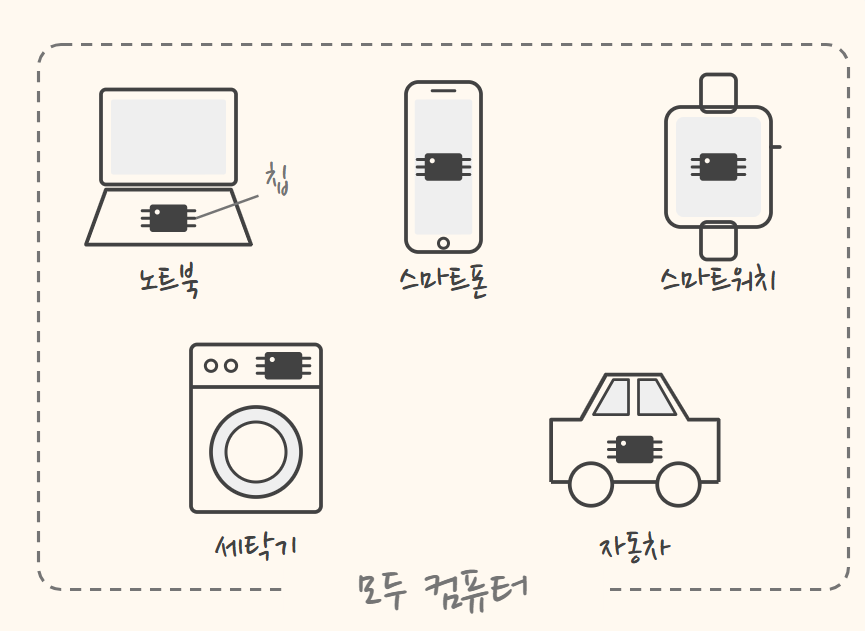
But not every computer is built from the same chips in the same configuration. A smartwatch must be small enough to wear on the wrist and run for a long time on a small battery. A desktop or laptop must handle all kinds of programs, from document editing to gaming. A computer in a car must process the information constantly streaming in from the vehicle within the time required. Because their jobs differ, what matters most for each also differs.
These differences shape which chips are used and how they are connected. A chip itself can be built to handle a wide range of work, or its internal structure can be tailored to process particular operations efficiently. A device’s capabilities are created jointly by the programs running on it and the chips that support them. So examining the chips is one way to understand what a device was built to do well.
Once you learn how chips work, you can understand not only the computer on your desk but also smartphones, washing machines, and cars from the perspective of the computer working inside them — because you can ask what information it remembers, what it computes, and what it sets in motion as a result. However different they look on the surface, the principles of the chips working underneath are connected. Even the reasons they are built differently are ultimately explained by the same principles. Now let’s see in what order we’ll explore these principles.